
Financial Decision Infrastructure
The shift from standalone lending applications to a coordinated layer that governs how decisions are made, executed and audited across the institution, treating decisioning as infrastructure, not a feature.
Explore the systems, orchestration models and intelligence layers powering real-time financial operations with Credisense.
The architectural domains that define modern financial decision infrastructure, and how Credisense approaches each.
The shift from standalone lending applications to a coordinated layer that governs how decisions are made, executed and audited across the institution, treating decisioning as infrastructure, not a feature.
An architecture in which each application emits events that trigger downstream processing, decoupling intake from execution, removing batch dependencies and letting throughput scale independently.
Embedding model-driven signals, graded recommendations and confidence scoring into operational workflows, under human accountability, with full rationale and traceability.
Expressing credit policy as versioned, testable logic that executes consistently across channels and can be simulated and challenged before it reaches production.
Decisions that resolve the moment data arrives, with every step observable and traceable end to end, no overnight cycles, no queues between intake and outcome.
Real-time access to transactional and financial data, normalised into decision-ready signals across markets and providers through a single connectivity layer.
Coordinating identity, biometric and fraud signals into a single, real-time risk view at the point of decision, rather than siloed checks bolted on after the fact.
Versioned change control, role-based access and complete decision lineage, so every outcome is reconstructable for audit, dispute and regulatory review.
Exposing every capability through documented APIs, so institutions compose decisioning into existing systems rather than undertaking rip-and-replace programmes.
Coordinating document generation, core systems, compliance services and partner APIs after the decision is made, closing the loop from intake to fulfilment.
Longer-form positioning on where financial operations are heading, and the architecture required to get there.
For most lenders, credit decisioning has accumulated across a decade of point solutions, a rules engine here, a bureau integration there, a manual review queue in between. Each was sound in isolation; together they form an operating model that is hard to change, hard to audit and slow to scale.
Decision infrastructure reframes the problem. Rather than another application sitting alongside the others, it is the coordination layer that governs how data is gathered, how policy executes and how outcomes are recorded, consistently, across every channel and product. The shift mirrors what happened in payments and identity: capabilities that were once bespoke became shared infrastructure, and the institutions that adopted it moved faster with less operational risk.
Batch processing assumes time can be borrowed, that a decision can wait for an overnight run, a reconciliation window, a scheduled job. Real-world financial operations no longer have that slack. Customers expect outcomes in seconds, and regulators expect every step to be accounted for.
Event-driven architecture treats each application as a stream of events: data arrives, signals are evaluated, policy executes, downstream systems react, each step triggered by the last, none waiting on a clock. Ingestion is decoupled from processing, so a surge in volume doesn't cascade into a backlog, and a slow provider doesn't stall the whole pipeline. The result is an operation that is both faster and more resilient than the batch systems it replaces.
The question for most credit teams is no longer whether to use AI, but where it belongs. A model that produces a score in isolation creates as many questions as it answers: how was it reached, can it be explained, and who is accountable for the outcome.
Embedding intelligence into the workflow, rather than alongside it, changes the calculus. Models interpret policy, synthesise bureau, behavioural and financial signals, and attach calibrated confidence to each assessment. Recommendations are surfaced to the assessor, never substituted for them, and every suggestion carries its rationale. AI becomes operational augmentation: it directs attention, supports consistency and preserves the human accountability that regulated lending requires.
Credit policy rarely lives in one place. It is encoded in a rules engine, hard-wired into integrations, captured in assessor judgement and documented in procedures that drift apart over time. Changing it means changing all of them, and proving the change was safe.
Treating policy as versioned, testable logic brings it back under control. Policy is expressed once, executed consistently wherever decisions are made, and validated through champion / challenger testing on real outcomes before rollout. Multi-system environments stay coherent because the policy layer, not the individual systems, is the source of truth, and every version is auditable.
The modern lending stack is an ecosystem: bureaus, identity providers, open-banking feeds, fraud services, core systems and partner APIs, each evolving on its own timeline. The competitive question is no longer which systems an institution uses, but how well it coordinates them.
Orchestration is the discipline of making that ecosystem behave as one. A coordination layer connects the inputs, executes the decision and drives the downstream actions, adapting as providers change without re-architecting the operation. The institutions that treat orchestration as core infrastructure will adopt new capabilities faster, enter new markets sooner and operate with a level of control their competitors cannot match.
Credisense sits between the systems an institution already runs, coordinating data, identity, intelligence and policy into a decision, then driving every downstream action.
Channels & data
Operational coordination layer
Credisense
Execution & services
One coordination layer, one real-time decision, composed across the ecosystem an institution already depends on.
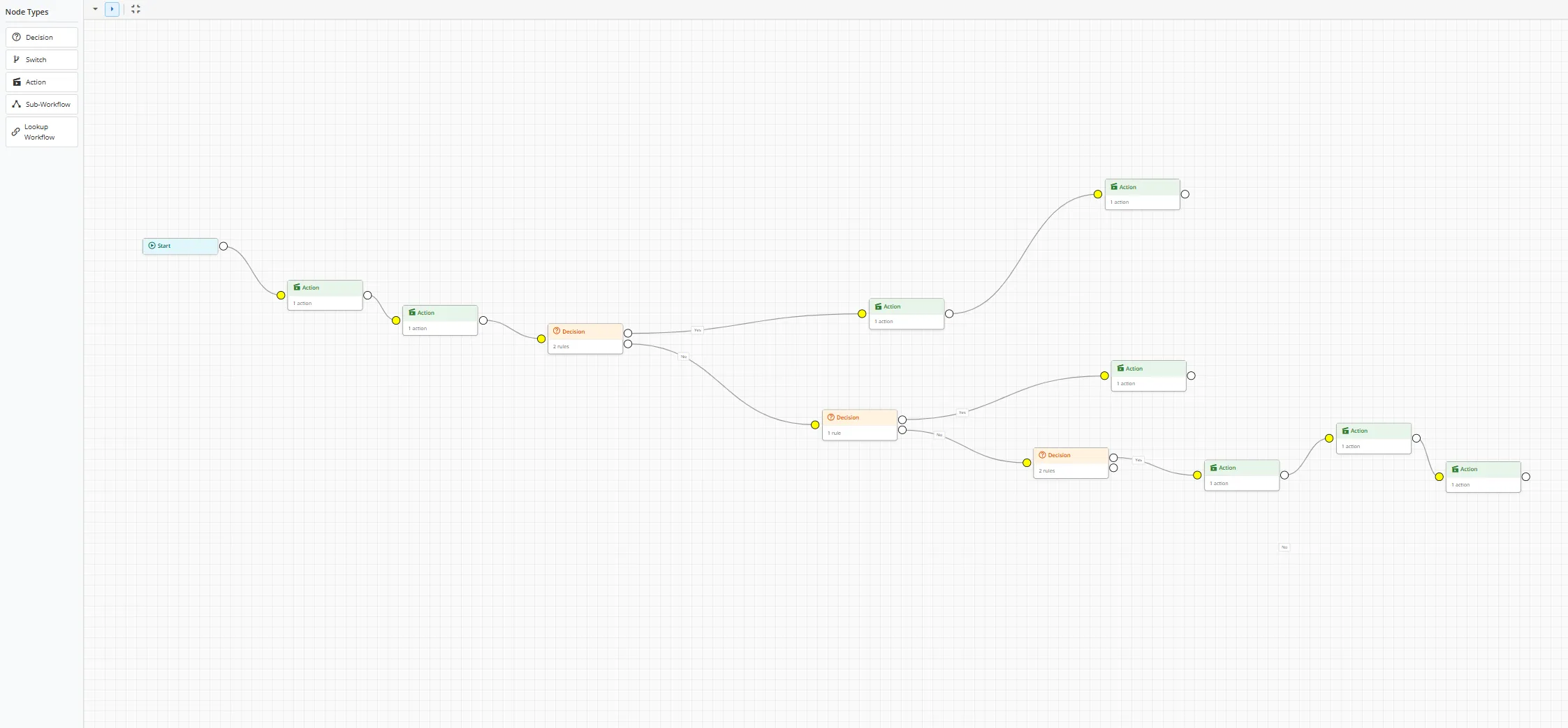
Workflow designer, the orchestration layer, configured.
The principles that govern how the platform is built, and how decisioning behaves in production.
Composes into existing systems through documented APIs, built to connect, not to replace.
Operational visibility into throughput, latency and decision flow across the whole pipeline.
Complete, reconstructable decision lineage from input to outcome, retained for review.
Capabilities coordinated as independent, composable services rather than a monolith.
Decisions resolve the moment data arrives, no batch windows, no queues.
Intelligence embedded into workflows to support accountable human decisions.
Decoupled, event-driven processing that absorbs load and isolates failure.
Encryption, role-based access and governed connectivity across every interface.
Horizontally scalable infrastructure that grows with volume, not against it.
Credisense is the operational coordination layer for real-time financial decisioning, connecting the ecosystem, embedding intelligence and executing at enterprise scale.